Powered by SignalTuned. Signal over noise — ten rules for building a roster that wins across seasons, not weekends, and the engine features that turn each one into a move.
Production is a snapshot. The age curve is the trajectory. Running backs hit their peak around age 23 and decline sharply by 29. Wide receivers peak around 26 and hold value longer. Tight ends peak around 25 but plateau into their early 30s. Quarterbacks peak near 29–30 and age slowest of all. Price every player against where he actually sits on his position's curve — not against the highlight reel you remember.
How SignalTuned helps
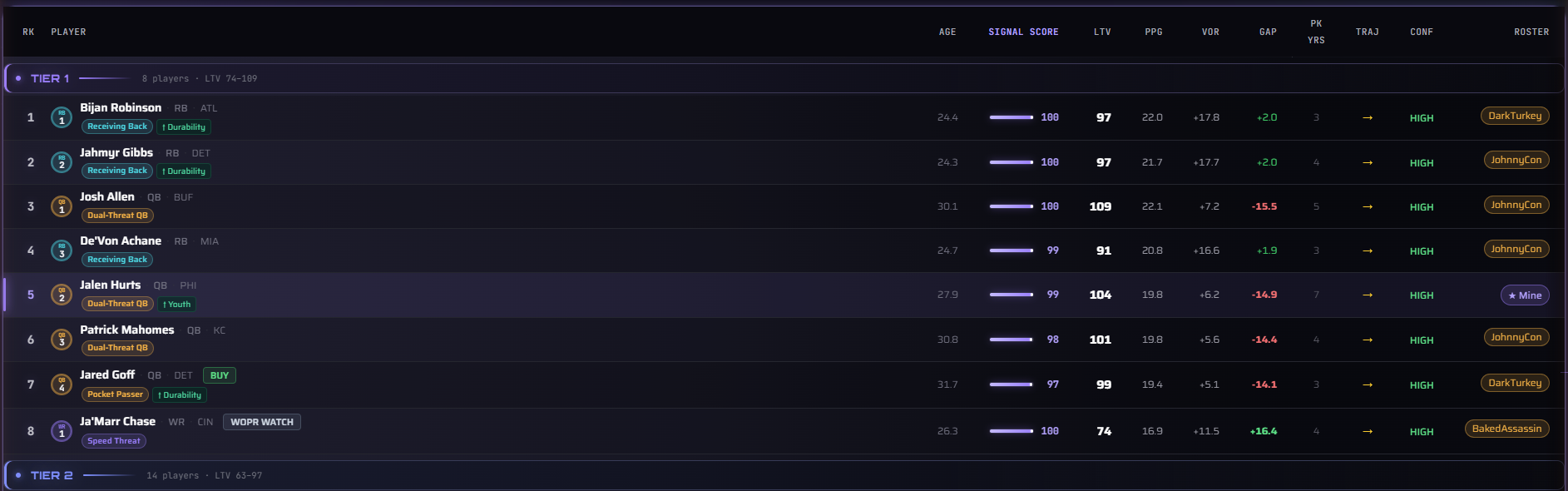
The rankings board carries a Traj column for every player. A green ↑ means he's still rising (a buy window), a yellow → means he's at his peak right now, and a red ↓ means age is catching up. Click any player to read the trajectory narrative behind the arrow.
Rankings · Traj columnEnlarge
II
II
Weigh draft capital, measurables, and production together.
Where the NFL drafts a rookie is the strongest single signal, but it is not the only one. SignalTuned starts each rookie from the historical outcomes of his draft-pick range, then adjusts up or down for athletic testing (speed and burst) and college production (his share of his college team's receiving production, yards per opportunity, and efficiency). Draft capital sets the floor; measurables and production move the projection from there.
How SignalTuned helps
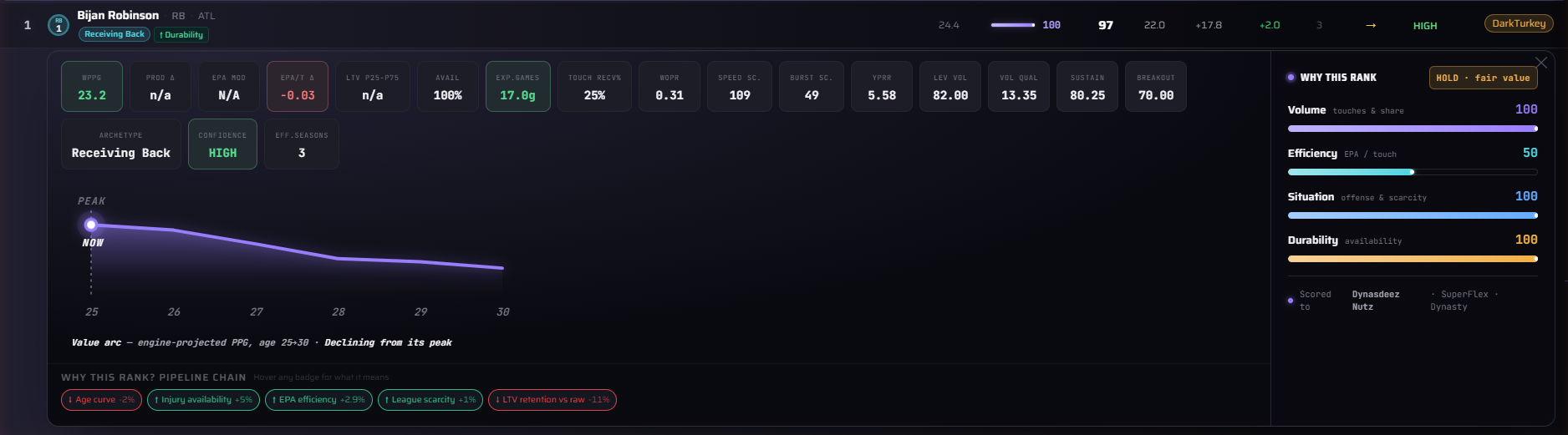
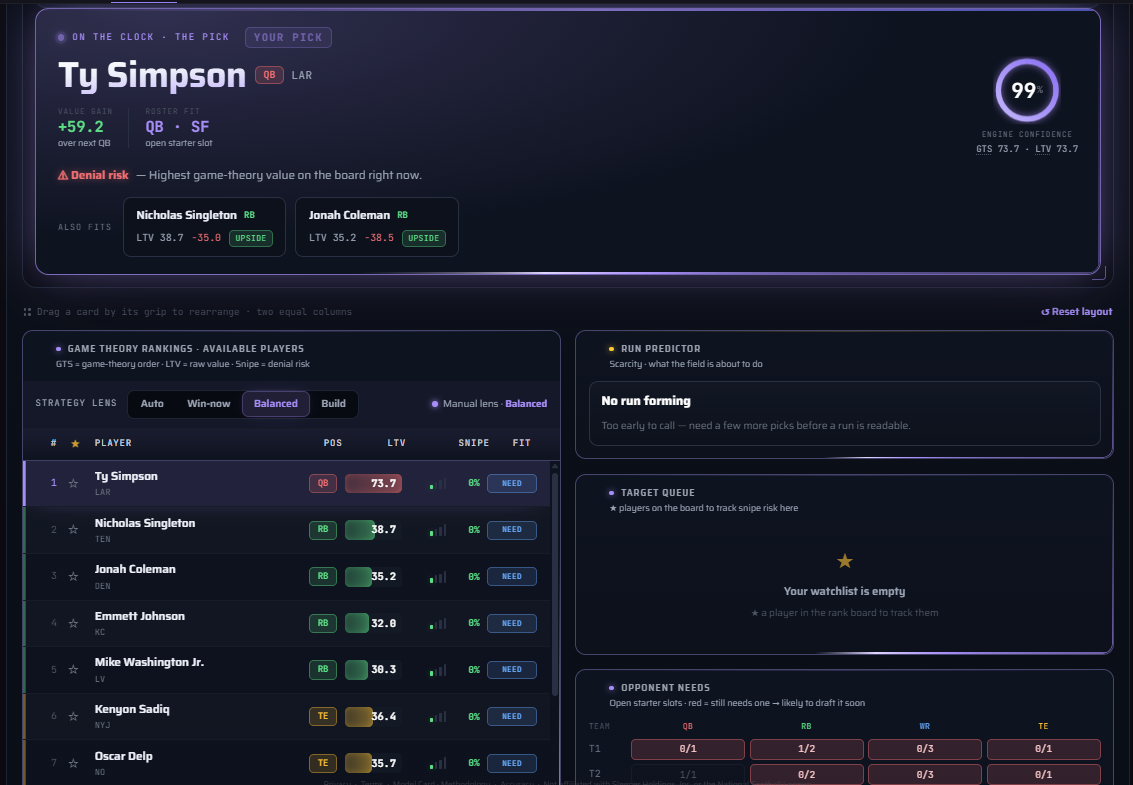
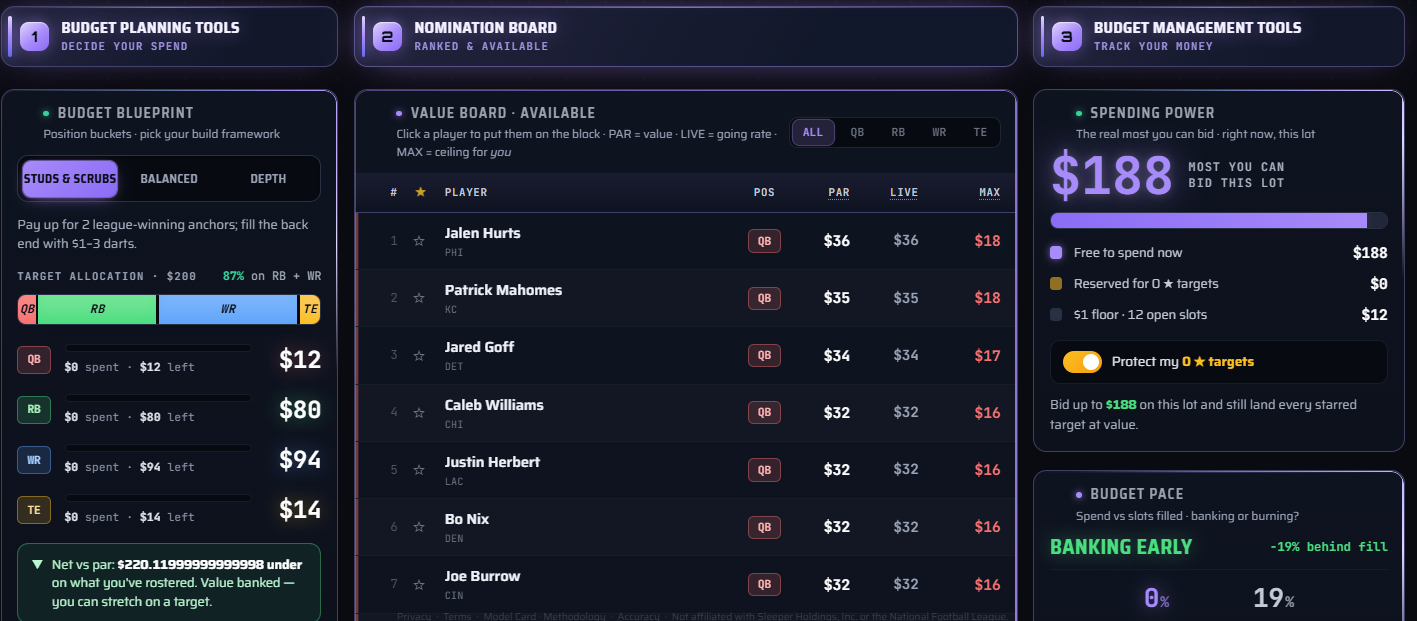
The rookie model fuses all three inputs and stamps a confidence tier right on the board in the Conf column: HIGH, MOD, LOW, or ROOK. You can see at a glance when a projection is well-supported versus leaning on draft slot alone — and hovering the badge gives you the full explanation. And when you actually draft — startup or rookie — the fully customizable War Room runs the same engine live: game-theory rankings and a Run Predictor for standard drafts, a Budget Blueprint and Spending Power for auctions.
Player card · Conf tierEnlarge
Draft War Room · StandardEnlarge
Auction War Room · AuctionEnlarge
III
III
Prize opportunity over efficiency.
Efficiency regresses. Volume persists. Targets, carries, and air-yards share are far stickier year over year than yards per touch or touchdown rate. Chase the players whose role guarantees the ball — not the ones who did a lot with a little, because a lot with a little rarely repeats.
How SignalTuned helps
Click any player to expand their card and read the Volume Quality Score: 60+ flags elite receiving opportunity, while anything well below his positional peers is a thin role dressed up by efficiency. It puts usage, not luck, right in front of you.
Player card · Volume Quality metricsEnlarge
IV
IV
Fear the touchdown spike.
A twelve-touchdown season on mediocre volume is a sell signal, not a foundation. Touchdowns are the noisiest input in fantasy scoring. When a player's value is propped up by an unsustainable scoring rate, the market is paying you to exit. Take the money.
How SignalTuned helps
The board flags the danger directly. Watch for the ⚠ REGRESSION badge on a player's row, and open his card to check the Sustainability Score (a low score is your boom-bust warning) before the market catches up.
Rankings · ⚠ Regression flagEnlarge
V
V
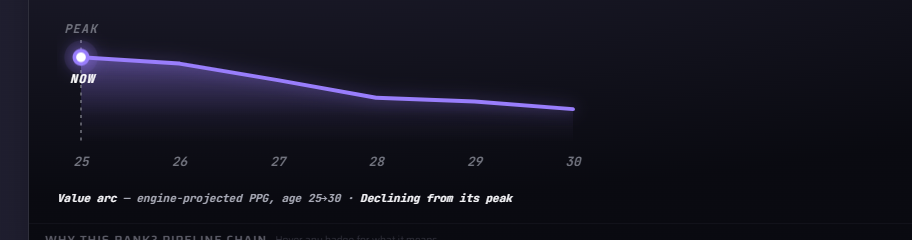
Build through the dip, not the decline.
There is a difference between a player slumping and a player declining. A slump is injury, scheme, or bad luck — and it is temporary. A decline is age and lost role — and it is permanent. Buy the dip. Sell the decline. Confusing the two is the most expensive mistake in dynasty.
How SignalTuned helps
The Traj column tells the two apart. A → Peak or ↑ Ascending narrative with strong volume is a dip worth buying, while a ↓ Declining tag tied to age is the real fall. Expand the player card and the engine spells out which discount is which.
Player card · Value arcEnlarge
VI
VI
Anchor in the positions that age well.
The longest-tenured value lives at quarterback and wide receiver. These are the positions where a 26-year-old is a multi-year asset, not a two-year rental. Anchor your roster in players whose curve gives you time — especially at quarterback in SuperFlex.
How SignalTuned helps
Every ranking is auto-calibrated to your exact league, SuperFlex included (you'll see it in your league header), so positional scarcity and curve longevity are already baked into the tier you're looking at.
VII
VII
Do not pay retail for consensus.
The market price reflects what the crowd already believes, which means consensus is rarely where the edge lives. Edge comes from disagreeing correctly. SignalTuned derives value mathematically from production, age, and your scoring settings — so your job is to find where the model and the market diverge, and act on it.
How SignalTuned helps
The board is your independent second opinion, and the BUY and SELL badges mark exactly where the engine disagrees with market price. Those badges are your shopping list.
Rankings · Buy / Sell badgesEnlarge
VIII
VIII
Treat picks as currency, not lottery tickets.
A future first is a known, tradeable value — not a magic bean. Know what each pick slot is worth, and move it the moment a proven asset is cheaper than the pick's expected outcome. Hoarding picks is hoarding variance.
How SignalTuned helps
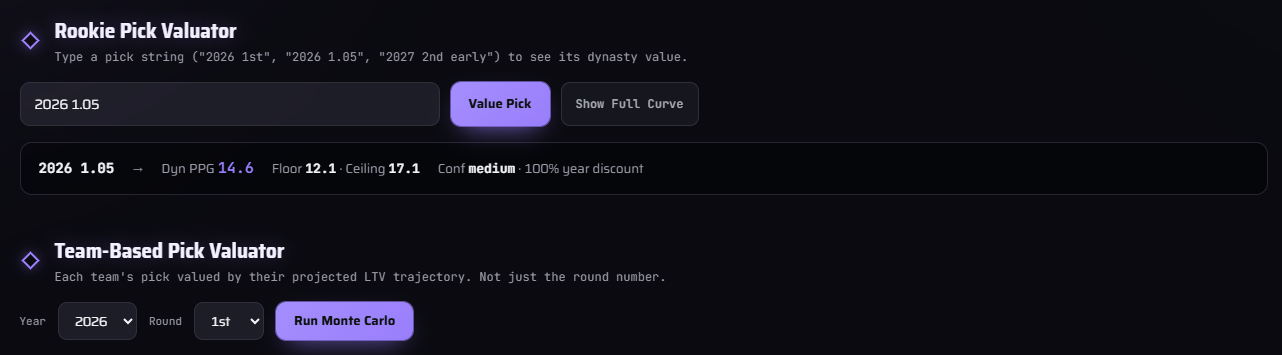
Head to the Trade Central tab. The Rookie Pick Valuator turns any pick string like “2026 1.05” into a concrete value, and the Team-Based Pick Valuator prices each team's future picks by their real trajectory — so you can weigh a pick against a player on equal footing.
Trade Central · Pick ValuatorEnlarge
IX
IX
Define thy window before thou tradest.
Contending and rebuilding call for opposite trades. The worst rosters are stuck in the middle, making win-now moves on a rebuild timeline. Decide which team you are first, then let every trade serve that verdict.
How SignalTuned helps
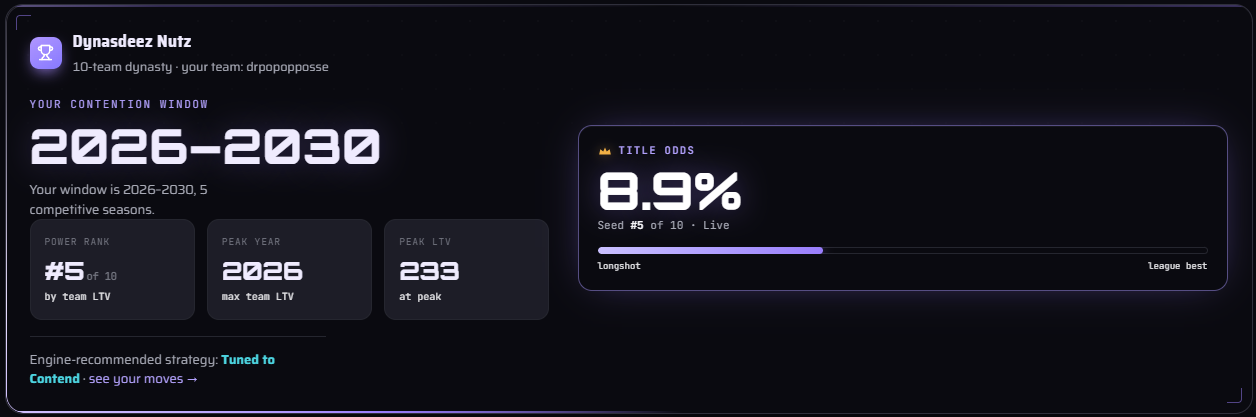
The Championship Odds gauge on your League Overview and the A–F Positional Grades in Recommendations tell you honestly whether you're a contender or a rebuilder. Decide your window there, then trade to it.
League Overview · Title odds + Positional GradesEnlarge
X
X
Have fun above all else.
This is a game, and games are meant to be fun. The engine exists to make you sharper, not to boss you around. Know why a ranking lands where it does, kick the tires on the outliers, and when your gut says draft the guy anyway — draft the guy. If you have conviction on a player or a pick the model is cooler on, awesome. That's your team, your call, and half the fun is being right when the spreadsheet was wrong. SignalTuned is a tool to sharpen your decisions, never a robot built to take your autonomy. When in doubt, do whatever makes the game most fun for you.
How SignalTuned helps
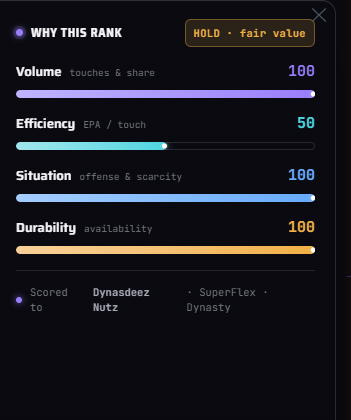
Every ranking comes with its reasoning attached. Click any player to see the why, so you're always informed — whether you ride with the model or back your own gut.